Explicit working-copy states
Represent where a document is in its lifecycle before deciding which operations are valid.
A desktop and backend workflow designed to make document-heavy work reliable when local editing, remote state and concurrent changes all intersect.
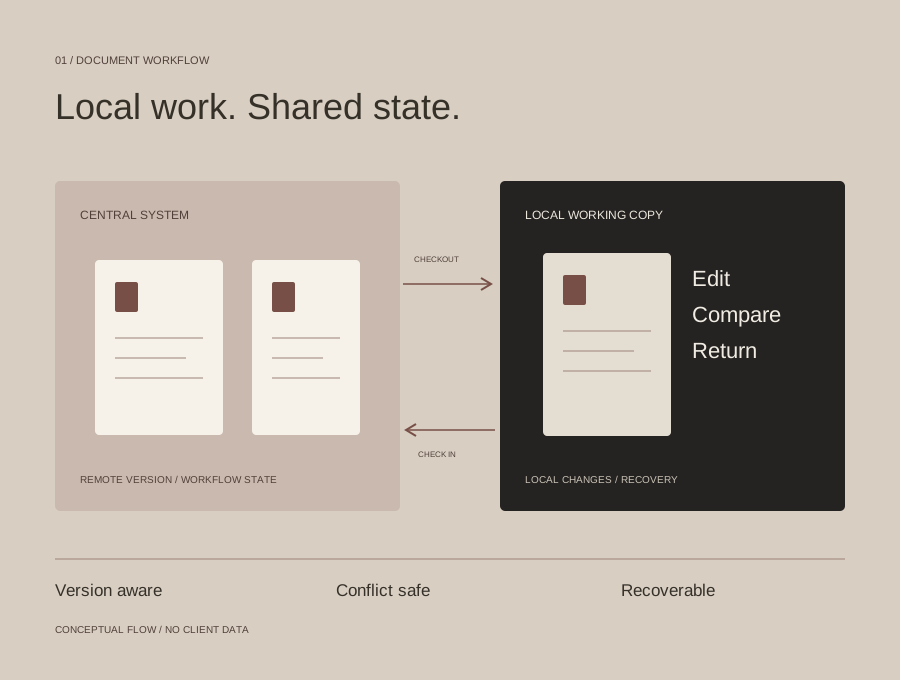
Users needed to take business documents from a central system, work on them locally with familiar desktop tools, and return their changes without losing track of versions or state. The desktop application had to fit that working process, not replace it.
The difficult part was not simply downloading and uploading files. Local files and remote state could change independently. Requests could be retried, versions could diverge, and an operation could stop halfway through.
A failed operation could not quietly destroy local changes or leave the user unsure which version was authoritative.
I worked across the desktop client and backend workflow. My work included document lifecycle behavior, local working-copy state, synchronization, conflict handling, recovery and UI state updates.
Making state visible was part of the engineering work: users should understand what happened without manually refreshing or knowing how the system works underneath.
I modelled the workflow around explicit states and deliberate transitions. An operation spanning desktop and backend was treated as a workflow rather than an isolated button action.
I paid particular attention to stale versions, retries and partially completed operations. Local work and remote state needed separate treatment, with a clear recovery path when they could not be reconciled automatically.
Conflicting version → preserve local work → resolve before check-in
Represent where a document is in its lifecycle before deciding which operations are valid.
Compare local and remote state before a change can overwrite valuable work.
Make repeated operations safe where appropriate, rather than assuming a request runs only once.
Keep a local working copy distinct from the authoritative remote version.
Handle partially completed work with recovery paths that protect the user’s changes.
Update UI state after an action and describe the result in language the user can act on.
Complex document state remains understandable to the user, local work is protected, and changes can return to a consistent backend workflow.
Selected identifying and implementation details are omitted because this work was completed for a client.